The twenty-third edition of the FIFA World Cup represents an unprecedented structural and logistical evolution in the history of global sporting events. Slated to occur from June 11 to July 19, 2026, the tournament is the first to be jointly hosted by three sovereign nations: Canada, Mexico, and the United States. This collaboration is not merely a geographic expansion but a fundamental shift in the tournament’s operational model, accommodating an expanded field of forty-eight teams, up from the thirty-two-team format that had been standard since 1998. The increase in participating nations necessitates a massive scaling of the match schedule, which will encompass a total of 104 matches over a thirty-nine-day duration. The strategic framework of the 2026 edition emphasizes regional clustering, infrastructure optimization, and a sophisticated media strategy designed to integrate sixteen host cities across four distinct time zones into a unified global experience.
USA – Soccer – FIFA World Cup
The Evolution of the Forty-Eight-Team Format
The expansion to forty-eight teams, finalized by the FIFA Council in early 2017 and refined in March 2023, introduces a new era of inclusivity and competitive complexity. The initial proposal of sixteen groups of three teams was ultimately superseded by a structure featuring twelve groups of four teams. This transition was primarily driven by the need to protect the sporting integrity of the group stage, as groups of three are statistically more susceptible to collusion during final matchdays. Under the twelve-group system, every team is guaranteed a minimum of three matches, maintaining the traditional round-robin tension that characterizes the tournament’s opening phase.
The progression logic for the knockout stage has been significantly altered to accommodate the larger field. The top two teams from each of the twelve groups will automatically qualify for the knockout phase. To reach a thirty-two-team bracket, these twenty-four teams are joined by the eight best third-placed teams across all groups. This introduces a “new” knockout round—the Round of 32—which doubles the number of elimination matches compared to previous editions. Consequently, teams reaching the final four will now play eight matches instead of the seven required under the previous format.
Group Stage Composition and Draw Overview
The draw for the 2026 World Cup has distributed the forty-eight qualified nations into a matrix that balances historical footballing power with emerging regional representation. The three host nations are anchored in specific groups to ensure they play their initial fixtures on home soil. Mexico is positioned in Group A, Canada in Group B, and the United States in Group D.
| Group | Anchor Team | Key Contenders and Debutants |
|---|---|---|
| Group A | Mexico | South Africa, South Korea, Czechia |
| Group B | Canada | Switzerland, Qatar, Bosnia and Herzegovina |
| Group C | Brazil | Morocco, Scotland, Haiti |
| Group D | USA | Paraguay, Australia, Turkiye |
| Group E | Germany | Ivory Coast, Ecuador, Curaçao |
| Group F | Netherlands | Japan, Tunisia, Sweden |
| Group G | Belgium | Egypt, Iran, New Zealand |
| Group H | Spain | Cape Verde, Saudi Arabia, Uruguay |
| Group I | France | Senegal, Iraq, Norway |
| Group J | Argentina | Algeria, Austria, Jordan |
| Group K | Portugal | Colombia, Uzbekistan, DR Congo |
| Group L | England | Croatia, Ghana, Panama |
The inclusion of debutants such as Cape Verde, Curaçao, Jordan, and Uzbekistan signifies the global reach of the expanded format, providing these nations with a historic opportunity to compete on the world’s most prestigious stage.
Regional Clusters and Venue Infrastructure
The sixteen host cities are organized into three geographic clusters—West, Central, and East—to manage the vast distances of North America and reduce the travel burden on teams and supporters. This clustering is a vital component of the logistical strategy, allowing for more efficient movement between match sites during the group stage.
Venue Profiles and Technical Specifications
The stadiums selected for the 2026 World Cup represent a mix of iconic historical venues and state-of-the-art modern arenas, most of which are home to National Football League (NFL) teams or Liga MX clubs.
| City | Stadium (Tournament Name) | Capacity | Primary Region |
|---|---|---|---|
| Mexico City | Estadio Azteca (Mexico City Stadium) | 83,000 | Central |
| NY/NJ | MetLife Stadium (NY/NJ Stadium) | 82,500 | East |
| Dallas | AT&T Stadium (Dallas Stadium) | 94,000 | Central |
| Atlanta | Mercedes-Benz Stadium (Atlanta Stadium) | 75,000 | East |
| Kansas City | Arrowhead Stadium (KC Stadium) | 73,000 | Central |
| Houston | NRG Stadium (Houston Stadium) | 72,000 | Central |
| San Francisco | Levi’s Stadium (SF Bay Area Stadium) | 71,000 | West |
| Los Angeles | SoFi Stadium (LA Stadium) | 70,000 | West |
| Philadelphia | Lincoln Financial Field (Philly Stadium) | 69,000 | East |
| Seattle | Lumen Field (Seattle Stadium) | 69,000 | West |
| Boston | Gillette Stadium (Boston Stadium) | 65,000 | East |
| Miami | Hard Rock Stadium (Miami Stadium) | 65,000 | East |
| Vancouver | BC Place (BC Place Vancouver) | 54,000 | West |
| Monterrey | Estadio BBVA (Estadio Monterrey) | 53,500 | Central |
| Guadalajara | Estadio Akron (Estadio Guadalajara) | 48,000 | Central |
| Toronto | BMO Field (Toronto Stadium) | 45,000 | East |
The Estadio Azteca holds particular historical significance, as it will become the first stadium to host the opening match of three separate World Cups, having previously done so in 1970 and 1986. Its designation as the venue for the tournament opener on June 11, 2026, solidifies its status as a “cathedral” of world football. In contrast, the selection of MetLife Stadium for the final match on July 19, 2026, emphasizes the commercial and cultural pull of the New York/New Jersey metropolitan area, which is expected to serve as the epicenter for the tournament’s conclusion.
The Opening Phase: Launching a Continental Event
The tournament begins with a concentrated series of matches involving the host nations within the first twenty-four hours. This strategy is designed to ignite regional interest and establish the unique nature of a three-host competition from the very first whistle.
Initial Match Schedule (June 11–13, 2026)
The opening fixture, Match 1, features Mexico against South Africa in Mexico City. The event will be a momentous occasion for Mexican football, with the national team playing on home soil before an expected capacity crowd.
| Match No. | Date | Fixture | Stadium | City | Kickoff (ET) |
|---|---|---|---|---|---|
| 1 | June 11 | Mexico vs. South Africa | Estadio Azteca | Mexico City | 3:00 PM |
| 2 | June 11 | South Korea vs. Czechia | Estadio Akron | Guadalajara | 10:00 PM |
| 3 | June 12 | Canada vs. Bosnia | Toronto Stadium | Toronto | 3:00 PM |
| 4 | June 12 | USA vs. Paraguay | SoFi Stadium | Los Angeles | 9:00 PM |
| 5 | June 13 | Haiti vs. Scotland | Gillette Stadium | Boston | 9:00 PM |
| 6 | June 13 | Australia vs. Turkiye | BC Place | Vancouver | 12:00 AM* |
| 7 | June 13 | Brazil vs. Morocco | MetLife Stadium | NY/NJ | 6:00 PM |
| 8 | June 13 | Qatar vs. Switzerland | Levi’s Stadium | San Francisco | 3:00 PM |
*Note: Kickoff for Match 6 occurs at midnight ET on June 14, representing the evening of June 13 in the Pacific time zone.
The scheduling of the US and Canadian openers on June 12 marks a historic day for football in those nations. Canada’s match in Toronto will be the first men’s FIFA World Cup match held on Canadian soil, while the US return to Los Angeles—the site of many of their 1994 World Cup matches—represents a full-circle moment for the sport in the United States.
Group Stage Analysis: Narratives and Fixture Density
The group stage, running from June 11 to June 27, consists of seventy-two matches played across the sixteen venues. This period is characterized by intense fixture density, with up to six matches per day during the final days of the group stage to ensure that teams in the same group play simultaneously, thereby mitigating any competitive disadvantage.
Group A and Group B: Host Momentum
Mexico’s Group A journey involves a return to Guadalajara for their second match on June 18 against South Korea, before concluding the group stage in Mexico City against Czechia on June 24. This rotation ensures that both major Mexican football hubs participate in the host nation’s narrative.
In Group B, Canada will travel from Toronto to Vancouver for their remaining fixtures. On June 18, they face Qatar at BC Place, followed by a final group match against Switzerland on June 24. The move to the West Coast is a strategic use of the regional cluster system, positioning Canada’s second and third matches in a time zone that facilitates Pacific viewership.
Group C and Group D: Strategic Matchups
Group C features the highly anticipated Brazil vs. Morocco match on June 13. This fixture, hosted at MetLife Stadium, is viewed as a marquee event for the East Coast, pitting the five-time champions against the surprise semi-finalists of the 2022 edition. Group D, led by the United States, sees the host nation move from Los Angeles to Seattle to face Australia on June 19, before returning to Los Angeles for their final match against a playoff winner on June 25.
Standard Kickoff Windows and Global Broadcasting
The scheduling of matches across four kickoff windows (12:00 PM, 3:00 PM, 6:00 PM, and 9:00 PM Eastern Time) is a sophisticated attempt to serve both domestic fans and the massive international television markets. The 3:00 PM ET window is particularly significant, as it corresponds to 8:00 PM in the United Kingdom and 9:00 PM in Central Europe, capturing the prime-time audience in two of the sport’s most lucrative commercial regions.
| Window (ET) | UK Time (BST) | Europe Time (CEST) | Audience Strategy |
|---|---|---|---|
| 12:00 PM | 5:00 PM | 6:00 PM | Early evening in Europe |
| 3:00 PM | 8:00 PM | 9:00 PM | Prime time in Europe/Africa |
| 6:00 PM | 11:00 PM | 12:00 AM | Late night in Europe, prime time Americas |
| 9:00 PM | 2:00 AM (+1) | 3:00 AM (+1) | Prime time Pacific, breakfast Asia |
The Inaugural Round of 32: A Double-Elimination Dynamic
The shift to a forty-eight-team format necessitates the introduction of the Round of 32, which replaces the Round of 16 as the first stage of the knockout phase. This stage, taking place from June 28 to July 3, 2026, is effectively a “second tournament” where the field is reduced from thirty-two to sixteen teams.
Round of 32 Schedule and Venue Assignments
| Match No. | Date | Source Teams | Venue | City |
|---|---|---|---|---|
| 73 | June 28 | Runner-up A vs. Runner-up B | SoFi Stadium | Los Angeles |
| 74 | June 29 | Winner E vs. 3rd A/B/C/D/F | Gillette Stadium | Boston |
| 75 | June 29 | Winner F vs. Runner-up C | Estadio BBVA | Monterrey |
| 76 | June 29 | Winner C vs. Runner-up F | NRG Stadium | Houston |
| 77 | June 30 | Winner I vs. 3rd C/D/F/G/H | MetLife Stadium | NY/NJ |
| 78 | June 30 | Runner-up E vs. Runner-up I | AT&T Stadium | Dallas |
| 79 | June 30 | Winner A vs. 3rd C/E/F/H/I | Estadio Azteca | Mexico City |
| 80 | July 1 | Winner L vs. 3rd E/H/I/J/K | Mercedes-Benz | Atlanta |
| 81 | July 1 | Winner D vs. 3rd B/E/F/I/J | Levi’s Stadium | San Francisco |
| 82 | July 1 | Winner G vs. 3rd A/E/H/I/J | Lumen Field | Seattle |
| 83 | July 2 | Runner-up K vs. Runner-up L | BMO Field | Toronto |
| 84 | July 2 | Winner H vs. Runner-up J | SoFi Stadium | Los Angeles |
| 85 | July 2 | Winner B vs. 3rd E/F/G/I/J | BC Place | Vancouver |
| 86 | July 3 | Winner J vs. Runner-up H | Hard Rock | Miami |
| 87 | July 3 | Winner K vs. 3rd D/E/I/J/L | Arrowhead | Kansas City |
| 88 | July 3 | Runner-up D vs. Runner-up G | AT&T Stadium | Dallas |
The Round of 32 matches in Mexico City and Toronto represent the final fixtures in those respective cities before the tournament narrows its focus. Match 79 in Mexico City is particularly critical, as it could feature the host nation if they win Group A, potentially providing the Estadio Azteca with one final moment of continental drama.
The Road to the Semifinals: Round of 16 and Quarterfinals
Following the Round of 32, the tournament transitions to the more traditional knockout structure, although the stakes are higher given the increased number of matches teams have already played. The Round of 16 occurs between July 4 and July 7, 2026.
Round of 16 Pairings
The Round of 16 features matchups that have been predetermined by the bracket structure, with winners of the Round of 32 advancing to face one another.
| Match No. | Date | Contestants | Venue | City |
|---|---|---|---|---|
| 89 | July 4 | Winner 74 vs. Winner 77 | Lincoln Financial | Philadelphia |
| 90 | July 4 | Winner 73 vs. Winner 75 | NRG Stadium | Houston |
| 91 | July 5 | Winner 76 vs. Winner 78 | MetLife Stadium | NY/NJ |
| 92 | July 5 | Winner 79 vs. Winner 80 | Estadio Azteca | Mexico City |
| 93 | July 6 | Winner 83 vs. Winner 84 | AT&T Stadium | Dallas |
| 94 | July 6 | Winner 81 vs. Winner 82 | Lumen Field | Seattle |
| 95 | July 7 | Winner 86 vs. Winner 88 | Mercedes-Benz | Atlanta |
| 96 | July 7 | Winner 85 vs. Winner 87 | BC Place | Vancouver |
A standout feature of the Round of 16 is the “Independence Day Football” narrative in the United States, with matches in Philadelphia and Houston scheduled for July 4. This represents a pinnacle for American soccer culture, potentially hosting knockout matches in historical hubs on the nation’s 250th anniversary.
The Elite Eight: Quarterfinal Logic
The quarterfinals represent the centralization of the tournament into its final stages, with all matches taking place within the United States. These games are scheduled for July 9 to July 11, 2026, and will be hosted in Boston, Los Angeles, Miami, and Kansas City.
| Quarterfinal | Date | Venue | City | Highest Round Significance |
|---|---|---|---|---|
| QF 1 (Match 97) | July 9 | Gillette Stadium | Boston | Major hub for New England fans |
| QF 2 (Match 98) | July 10 | SoFi Stadium | Los Angeles | West Coast centerpiece |
| QF 3 (Match 99) | July 11 | Hard Rock | Miami | Gateway to Latin America |
| QF 4 (Match 100) | July 11 | Arrowhead | Kansas City | Heartland of the US |
The quarterfinal in Kansas City is particularly noteworthy given the city’s deep commitment to youth soccer and its central location, making it an accessible hub for fans from across North America.
The Final Four: Semifinals and Third-Place Play-off
The final four teams will compete in the semifinals on July 14 and 15, 2026. These matches are assigned to two of the most technically advanced indoor stadiums in the world: Dallas and Atlanta.
Semifinal Schedule and Significance
| Semifinal | Date | Venue | Kickoff (ET) |
|---|---|---|---|
| SF 1 (Match 101) | July 14 | AT&T Stadium (Arlington) | 3:00 PM |
| SF 2 (Match 102) | July 15 | Mercedes-Benz (Atlanta) | 3:00 PM |
The selection of Dallas and Atlanta for the semifinals underscores FIFA’s desire for massive seating capacities (both stadiums can expand to approximately 100,000 for major events) and climate-controlled environments. This ensures that the high intensity of the penultimate round is not compromised by the peak summer humidity characteristic of the Southern United States in July.
Following the semifinals, the losing teams will move to Miami for the Third-Place Play-off on July 18, 2026. Often referred to as the “Bronze Final,” this match has gained significant prestige in recent years, serving as a platform for teams to celebrate a successful tournament run.
The 2026 World Cup Final: A Global Apex
The tournament concludes with the Final on July 19, 2026, at MetLife Stadium in East Rutherford, New Jersey. The selection of New York/New Jersey over competing bids from Dallas and Los Angeles highlights the region’s massive international transportation networks, diverse demographic profile, and its position as a global media capital.
The match is scheduled for a 3:00 PM ET kickoff, a strategic time that allows for prime-time viewing across Europe, Africa, and South America. For the fans in attendance, the gates are expected to open several hours early for a closing ceremony that will likely reflect the tri-national nature of the host partnership.
Time Zone Coordination and Logitational Complexity
Managing a tournament of this scale requires a comprehensive plan for time zone integration. The sixteen host cities cover three hours of difference from coast to coast, creating a complex web for fans attempting to follow every match.
| City | Time Zone | Offset from ET | Offset from UTC |
|---|---|---|---|
| NY/NJ, Miami, Toronto | Eastern (ET) | 0 hrs | UTC-4 |
| Dallas, KC, Mexico City | Central (CT) | -1 hr | UTC-5 |
| Denver, Phoenix* | Mountain (MT) | -2 hrs | UTC-6 |
| Los Angeles, Vancouver | Pacific (PT) | -3 hrs | UTC-7 |
*Note: While some cities listed are not host venues, they serve as team base camps and transit hubs.
This three-hour spread means that a match kicking off at 9:00 PM ET in New York occurs at 6:00 PM PT in Los Angeles. This disparity has led to criticisms from some fans who worry about early morning kickoffs for the Pacific Coast when matches are set for the 12:00 PM ET window. However, FIFA’s scheduling emphasizes “Prime Time for Everyone,” a philosophy that prioritizes evening windows in the Central and Eastern clusters to capture the largest possible domestic audience.
Economic Realities and the Fan Experience
The 2026 World Cup is anticipated to be the most commercially successful in history, with projected revenues from ticketing, hospitality, and sponsorships reaching record levels. However, this commercialization has led to concerns regarding ticket accessibility.
Ticket Categories and Pricing Tiers
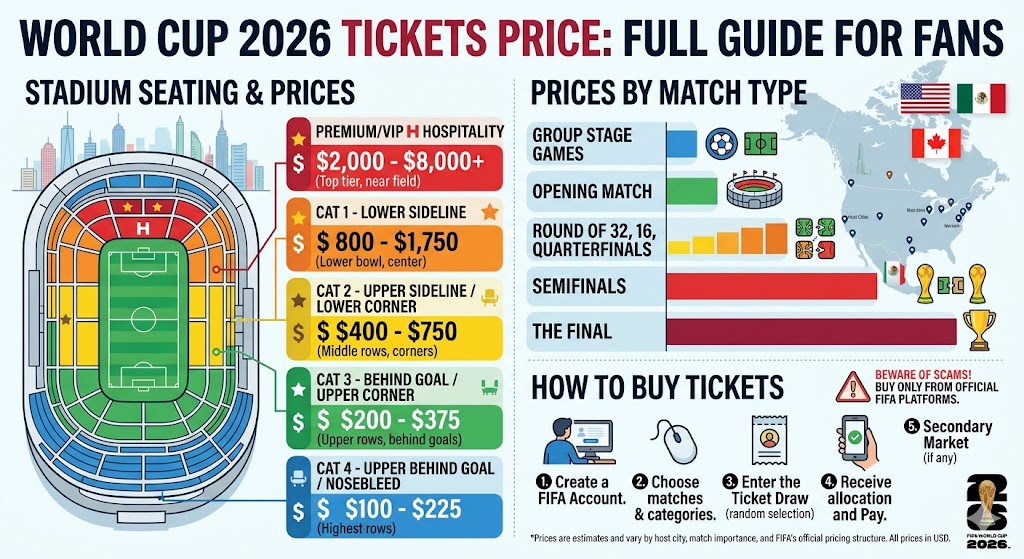
Early reports indicate that ticket prices for high-profile matches, such as the opening match in Mexico City, have fluctuated significantly in the resale market, with some category 1 seats reaching between $3,000 and $10,000. FIFA’s official ticketing system utilizes four categories to provide a range of entry points.
| Category | Tier Location | Typical View | Relative Price |
|---|---|---|---|
| Category 1 | Lower Tier | Premium sideline/center | Highest |
| Category 2 | Mid/Lower Tier | Corners and goal lines | High |
| Category 3 | Upper Tier | Pitch-wide visibility | Moderate |
| Category 4 | Upper Corners | Distance viewing | Lowest |
In addition to standard seating, the 2026 edition will feature extensive “Hospitality Series” packages. These include options like the “Pitchside Lounge” and “VIP Trophy Lounge,” targeted at high-net-worth individuals and corporate partners, particularly in cities like Mexico City, Dallas, and New York.
Milestones and Historical Context: The 1,000th Match
The 2026 tournament will reach a historic milestone in the history of the sport: the 1,000th match in the history of the FIFA World Cup. This match is scheduled to be the Group F fixture between Tunisia and Japan, taking place at Estadio BBVA in Monterrey on Saturday, June 20, 2026. The selection of Monterrey for this milestone match highlights Mexico’s enduring legacy as a host nation and the global diversity of the modern game, featuring teams from Africa and Asia.
Media and Global Outreach: A Continent Reconnected
The 2026 World Cup marks the return of the tournament to North America after thirty-two years, the last being USA 1994. Since that time, the footballing landscape in the three host countries has changed dramatically. Major League Soccer (MLS) and the professionalization of the Canadian game have created a more fertile ground for the sport’s growth, while Mexico’s passion for the Liga MX remains a cornerstone of North American sports culture.
The broadcast rights for the tournament are primarily held by FOX and FS1 in English for the US market, with Telemundo and Peacock providing Spanish-language coverage. The integration of streaming platforms like Peacock and Apple TV (via MLS connections) suggests a more digitally integrated World Cup experience than ever before, with live data, multi-angle views, and instant highlights becoming standard for viewers.
A Paradigm for the Future of International Sport
The 2026 FIFA World Cup is a massive undertaking that tests the limits of modern sports logistics and international cooperation. By expanding to forty-eight teams and 104 matches, FIFA has significantly increased the tournament’s footprint, reaching new markets and providing opportunities for more nations to participate in the global festival of football. The strategic use of regional clusters, a sophisticated day-by-day match schedule, and the utilization of world-class infrastructure in Canada, Mexico, and the United States ensure that the tournament remains a premier event despite its increased complexity.